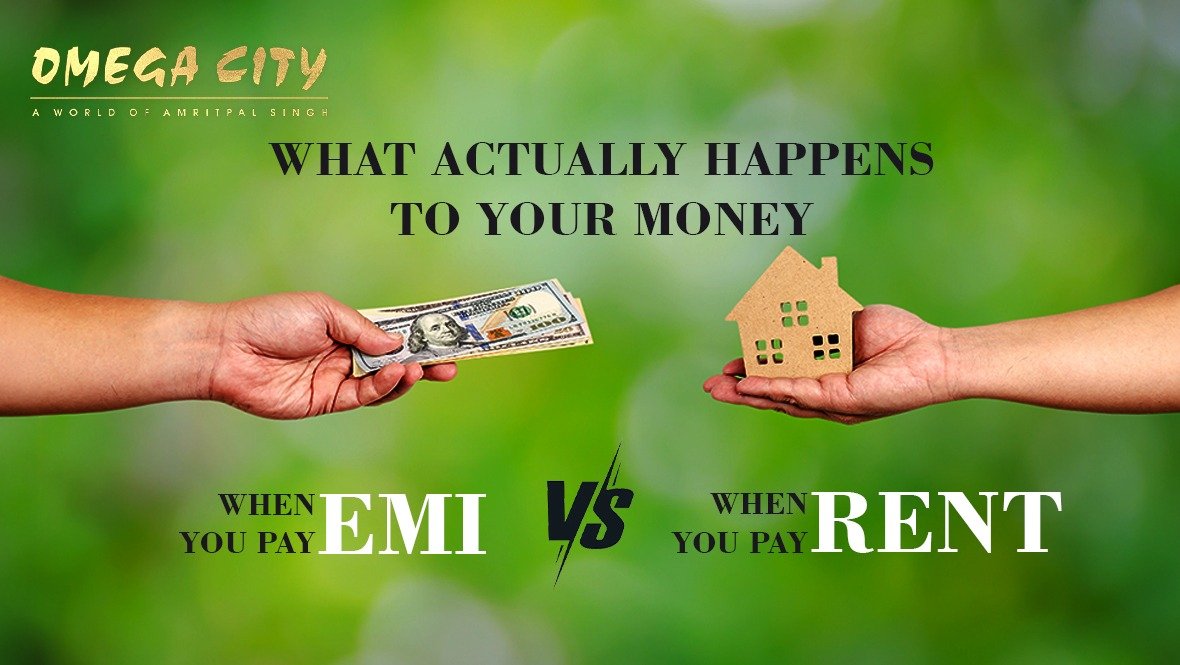
Quick Answer: When you pay rent, 100% of the money leaves your hands permanently in exchange for temporary shelter. When you pay an EMI, a portion goes toward interest (the cost of borrowing), but the remainder becomes equity ownership you keep. Over a 15–20 year horizon, EMI payments typically convert into a tangible asset, while rent leaves no financial residue.
The Core Difference in One Line
Rent buys you time in someone else’s property. EMI buys you ownership of your own.
That single distinction shapes everything else: your taxes, your savings, your sense of stability, and the financial story your future self will inherit.
What Is Rent, Really?
Rent is a recurring expense paid to a landlord in exchange for the right to live in a property for a fixed period, usually 11 months in India. Once paid, the money is gone. There is no asset, no equity, no return.
Rent suits specific life stages:
- Students searching for 2-bedroom student accommodation or 1 BHK flats near Chandigarh University
- Young professionals exploring rent deals for students in Tricity before settling
- Anyone needing a 2 BHK in Chandigarh for rent without brokerage during a short-term posting
- Families testing a neighborhood before committing to ownership
Rent is the price of flexibility, a valuable option, but it does not compound.
What Is an EMI, Really?
An EMI (Equated Monthly Installment) is a fixed monthly payment toward a home loan, split into two parts:
- Interest is the bank’s fee for lending you the money
- Principal, the actual ownership share you are building in the property
In the first few years, most of your EMI goes toward interest. However, with each passing month, the ratio shifts quietly. The principal portion grows. Equity builds. Eventually, you own a meaningful and often appreciating asset.
Where Each Rupee of Your EMI Goes
- Year 1–5: Roughly 70–80% interest, 20–30% principal
- Year 6–10: Closer to 50/50
- Year 11–20: Majority becomes principal ownership accelerates
- Throughout: Tax deductions under Section 80C (principal) and Section 24(b) (interest, up to ₹2 lakh annually)
Rent vs EMI: A Side-by-Side Comparison
| Factor | Paying Rent | Paying EMI |
| Asset ownership | None | Grows monthly |
| Tax benefit | HRA only (if salaried) | Section 80C + 24(b) |
| Flexibility | High move anytime | Low long-term commitment |
| Wealth creation | Zero | Builds equity + appreciation |
| Maintenance | Landlord’s responsibility | Yours |
| Monthly cost predictability | Can rise yearly | Fixed (or floating, but managed) |
| End-of-tenure outcome | No asset | Full ownership |
Why the Math Tilts Toward Ownership in the Tricity
The rent-vs-EMI equation is not universal. It bends with geography. In Chandigarh, Mohali, and Kharar, three forces have been reshaping the calculation:
- Steady appreciation Property prices in Mohali and Kharar have appreciated consistently over the past decade, driven by IT corridors and educational institutions.
- Improved supply, Ready-to-move RERA-approved flats have reduced the project-delay risk that once made buyers hesitate.
- Stronger rental yields. Pockets around Mohali now offer flats with high rental yield in Mohali, making ownership viable even for investors who don’t plan to occupy.
This is why searches for property for investment in Mohali, investment flats in Mohali with rental yield, and the best property in Mohali for NRIs and investors have grown sharply. The numbers genuinely support the shift.
A 15-Year Story: Two Friends, Two Choices
Imagine two people, both earning similarly, both spending ₹25,000 a month on housing.
- Person A rents a 2 BHK in Chandigarh for 15 years. Total outflow: ~₹45 lakh. Final asset value: ₹0.
- Person B takes a home loan and pays the same ₹25,000 as EMI on an Affordable 3 BHK flat near Chandigarh. After 15 years, they own ~60–70% of a property whose market value has likely doubled.
Neither made a wrong choice. Person A may have needed the flexibility. But Person B’s monthly outflow built something tangible.
What a Well-Planned Township Actually Looks Like
Choosing a home is not only a financial decision, it’s a decision about daily life. A flat is four walls; a township is the ecosystem that those walls sit inside. The difference shows up every morning and every evening.
When evaluating projects in the Tricity, look for these markers of a settled, well-planned community:
- Ready-to-move status with families already living there (a living township is a tested one)
- Highway-adjacent location with quick access to Chandigarh
- Gated security with 24/7 CCTV and controlled entry
- On-site convenience: grocery, pharmacy, salon, clubhouse
- Reliable utilities: power backup, dedicated water supply, internal roads
- A mix of unit configurations so the community is diverse rather than monolithic
A Working Example: Omega City, Kharar
Omega City, on NH-95 (Chandigarh-Ludhiana Highway) in Kharar, is a useful reference point for what a mature township in this corridor looks like. It is a ready-to-move project with over 1,000 families already in residence. The first phase has been occupied long enough to be tested by real life. The location places residents roughly 10–15 minutes from Chandigarh, with Chandigarh University and VR Punjab Mall within easy reach.
The township spans approximately 11–15 acres as a gated township project in Kharar, with:
- Clubhouse featuring a gym, swimming pool, and community hall
- 24/7 security with CCTV monitoring
- On-site essentials: grocery shops, pharmacy, salon
- Infrastructure: power backup, dedicated water supply, wide internal roads with LED street lighting
The configuration mix is unusually broad for a single township, which helps explain its appeal across buyer segments:
| Unit Type | Suitable For | Starting Range |
| Studio apartment / 1 BHK | First-time buyers, investors, students | From ~₹19.90 Lac |
| 2 BHK & 3 BHK (S+3 format) | Small families, end-users | Mid-range |
| 6 BHK Penthouse | Premium buyers, large families | Luxury segment |
For someone exploring a studio apartment in Chandigarh for sale or a studio apartment in Mohali for sale, the entry-level pricing here sits at a notably accessible threshold. For premium buyers comparing a 6 BHK penthouse in Tricity or a luxurious penthouse for sale, the same township offers that segment too.
Going Vertical: The Abraj Heights Shift
Within the larger Omega City township, Abraj Heights marks a different chapter a shift from the original S+3 (Stilt + 3) low-rise format into a high-rise S+9 to S+12 category. It signals how the best residential property in Kharar is evolving as the corridor matures.
What distinguishes the high-rise format:
- Primarily 3 BHK and 3+1 BHK (3 BHK with servant room) luxury apartments
- Dual orientation, most units are designed “both sides open” for better ventilation and natural light
- High-speed elevators are a meaningful upgrade over walk-up low-rise blocks
- Elevated views from upper floors look out toward the Shivalik foothills and the Tricity skyline
For buyers comparing 3 BHK rooms in Mohali, a 3 BHK in Chandigarh, or luxurious flats in Kharar, the vertical format brings something the low-rise stock cannot: light, air, and a long horizon line.
When EMI Makes Sense and When Rent Does
EMI is the better choice when:
- You plan to stay in the same city for 5+ years
- Your income is stable and predictable
- You can manage the down payment without depleting your emergency fund
- You’re targeting growth corridors with active development like Kharar and Mohali
- You want long-term wealth creation alongside shelter
Rent is the better choice when:
- You’re in a transitional career or life phase
- You’re a student needing apartments for students near campus
- You haven’t yet decided which city or neighborhood feels right
- Your timeline is shorter than 3 years
Who Is Buying What in the Tricity Today
- Young couples and small families: 2 BHK apartments in Chandigarh, 3 BHK apartments in Chandigarh, small families, affordable luxury apartments near Chandigarh
- Established families: 3 BHK luxury homes in Chandigarh, luxury 3 BHK apartments in Chandigarh, high-rise 3+1 BHK formats
- NRIs and investors: 1 BHK apartments in prime location Mohali, 1 BHK in prime location townships, best ROI flats in Chandigarh
- Premium buyers: 6 BHK penthouse in Kharar, 6 BHK penthouse in Chandigarh, Luxurious penthouse for sale in Kharar
- First-time buyers: 1 BHK apartment in Kharar Mohali, premium 1 BHK flats in Chandigarh, studio formats
The right choice is rarely about the property type alone; it’s about how the property fits your timeline, income, and intent.
A Quieter Truth: A Home Is More Than a Financial Instrument
Spreadsheets capture the math. They do not capture what changes inside you when a place becomes truly yours.
You stop asking permission to paint a wall. You plant something on the balcony knowing you’ll watch it bloom. The home stops being a transaction and becomes a sthaan, a place of belonging.
Whether someone is drawn to affordable luxury flats in Tricity, a 3 BHK flat in Chandigarh within their budget, or simply flats for sale in Chandigarh that feel right, the deeper need is the same: a door that opens to their own name.
Frequently Asked Questions
Is paying EMI always better than paying rent?
No. EMI is better when your timeline exceeds 5 years, and your income is stable. For shorter stays or uncertain career phases, rent is often the wiser choice.
How much should my EMI be relative to my income?
A widely used rule is that your total EMIs should not exceed 40% of your monthly take-home pay.
Are RERA-approved flats safer to buy?
Yes. RERA registration provides legal recourse, project timeline guarantees, and transparency on builder commitments, significantly reducing buyer risk.
Is Kharar a good location for first-time buyers?
Kharar offers a favorable price-to-quality ratio, NH-95 connectivity, and a growing stock of gated townships. Ready-to-move projects like Omega City reduce risk for first-time buyers compared with under-construction options.
What’s the difference between an S+3 and an S+9 building?
S+3 means Stilt plus 3 floors, a low-rise format, usually walk-up. S+9 or higher indicates a high-rise with elevators, often offering better ventilation, views, and modern infrastructure.
Is Mohali a good location for investment?
Mohali has shown consistent price appreciation and strong rental yields in select micro-markets, making it appealing for both end-users and investors, including NRIs.
Summary
Rent and EMI are not opposites they are two different relationships with the same need for shelter. Rent gives you flexibility but no foothold; EMI gives you a foothold but demands commitment. Money flows out every month either way; the only question is whether that flow is building something for your future self.
For renters in early life stages, rent is honest and appropriate. For those with stable income and a 5+ year horizon, EMI quietly converts a monthly expense into ownership, equity, and often appreciation. In growth corridors like Kharar and Mohali, the math has been tilting toward ownership for years, supported by RERA reforms, ready-to-move inventory, and mature townships such as Omega City and its high-rise extension Abraj Heights, which together illustrate how this corridor has evolved from low-rise S+3 blocks into full-fledged vertical communities.
Choose with patience. The best housing decision is rarely the cheapest or the grandest; it’s the one that fits the life you are actually building.